Published August 21, 2026.
Weekend Coverage Handoff Boards for Steadier Trucking Office Routines
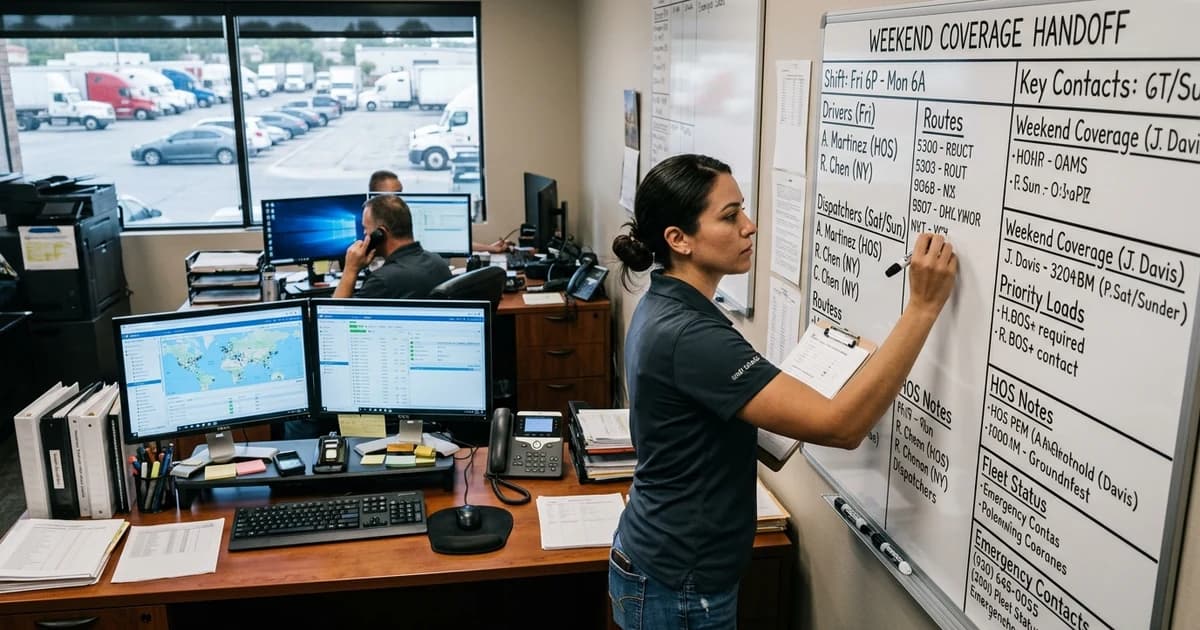
A weekend coverage handoff board makes open trucking office work visible across shifts, with clear owners, sources, and escalation boundaries. This practical guide is for carrier owners, dispatchers, operations managers, and administrative staff who need a dependable office routine while keeping operational, regulatory, financial, employment, and contractual authority with the appropriate people.
Start before the last shift
Weekend coverage works best when the handoff starts before the regular team signs off. Collect open loads, unanswered messages, document requests, vendor callbacks, and customer questions from the carrier’s approved systems. Each item needs an identity, current state, next action, owner, and source. A board that only lists urgent items leaves ordinary tasks invisible until they become urgent.
Use the carrier’s definitions for priority and coverage. Do not label a matter critical simply because it is unfamiliar or because a message uses strong language. If the consequence is unclear, route it to the manager or dispatcher who owns the decision. The board should explain the question, not decide its importance by guesswork.
Separate current from pending
A handoff should distinguish confirmed facts from requests, estimates, and assumptions. Put the latest reliable source beside the current status and add a separate field for what is waiting. This keeps a weekend coordinator from reading a proposed appointment change as a confirmed one or treating a vendor promise as a completed repair.
If a task has no next action, it is not ready for handoff. Ask the departing owner to clarify whether the item is complete, waiting, or intentionally paused. A short clarification before the shift change saves a long reconstruction later.
Design for the first scan
The person receiving coverage may have many records to review. Put the affected load, unit, driver, customer, or vendor first, followed by the action and timing. Use consistent labels and avoid paragraphs in the queue view. Keep supporting detail one click or one file reference away.
A good board can be read in a few minutes and then used as a map to the underlying systems. It should not attempt to hold every message. Summaries are useful only when they point to the source and make their own limits visible.
Set escalation triggers
Coverage notes should say when the assistant must contact the on-call dispatcher, manager, safety owner, maintenance owner, or customer lead. Triggers can include a conflicting instruction, an official request, a suspected safety issue, an unapproved commitment, or a deadline the carrier has defined. Keep the trigger factual and route the decision to the role that owns it.
Do not turn a boundary into a dead end. Include the information the escalation owner will need: source, identifiers, last action, and question. A named route is more useful than a generic instruction to “ask someone.”
Handle no-response work
A message with no reply needs a next check date and an owner. Record attempts and avoid sending duplicate outreach through several channels unless the carrier’s procedure calls for it. If a response is time-sensitive, state the carrier-supplied reason without inventing a consequence.
No response is not the same as approval, refusal, or completion. Keep the status open until the process provides a close signal. This simple rule prevents a quiet inbox from being mistaken for a resolved weekend queue.
Preserve sensitive boundaries
Coverage may expose employment, medical, payment, customer dispute, or compliance information. Put only necessary routing details on the broad board and keep restricted source files in approved locations. Use neutral wording and follow the carrier’s access policy. A handoff should improve continuity without becoming a new uncontrolled copy of the record.
If a coverage request asks the assistant to make a decision outside the role, return the facts and escalate. A weekend shift does not expand authority. Clear boundaries protect the carrier, the staff, and the person waiting for an answer.
Close the weekend cleanly
At the end of coverage, record what changed, what remains open, and who receives the next handoff. Link each closed item to its source or completion signal. If a task was not completed, preserve the reason and next owner instead of clearing it to make the board look tidy.
Review repeated weekend exceptions for a process improvement: a missing field, a confusing label, or a coverage rule that nobody can find. Assign the change to a weekday owner. Stable routines come from carrying lessons back into the normal workflow.
Prepare a handoff that can stand alone
A departing coordinator should leave enough context for the covering person to begin with the approved systems rather than reconstructing a conversation from memory. For each open item, record the affected load, unit, driver, customer, or vendor; the latest source; the current status; the next action; and the time or condition for checking again. If the item is waiting on a reply, include the date of the last attempt and the channel used. If it is waiting on a decision, name the decision owner and state the factual question that needs an answer.
Keep routine work visible beside exceptions. Document requests, appointment confirmations, inbox follow-ups, and vendor callbacks can disappear when a board contains only urgent language. Use the carrier’s own priority definitions and avoid inventing a consequence for a missed response. The covering coordinator can then work through the queue in a deliberate order while escalating matters that need dispatch, safety, maintenance, finance, or management authority.
At the end of the shift, compare the board with the approved inboxes and operational records. Remove only items with a documented close signal, and carry forward everything that remains open. A clean handoff is not an empty board; it is a truthful account of what changed, what is still waiting, and who should receive the next update.
A final record check
Before closing a weekend coverage handoff board item, confirm that the source is identifiable, the latest status is supported, the next action has an owner, and any unresolved judgment has been routed to the authorized person. A strong administrative routine makes the next decision easier to inspect; it does not hide uncertainty or claim authority it does not have.
Questions to keep visible
- Which source supports the current status?
- What remains open, and who owns the next action?
- Is a professional, operational, financial, employment, or contractual decision waiting for an authorized reviewer?
This article provides administrative guidance for trucking offices. Apply the carrier’s policies and obtain qualified advice for legal, regulatory, safety, maintenance, tax, payroll, employment, or contractual decisions.