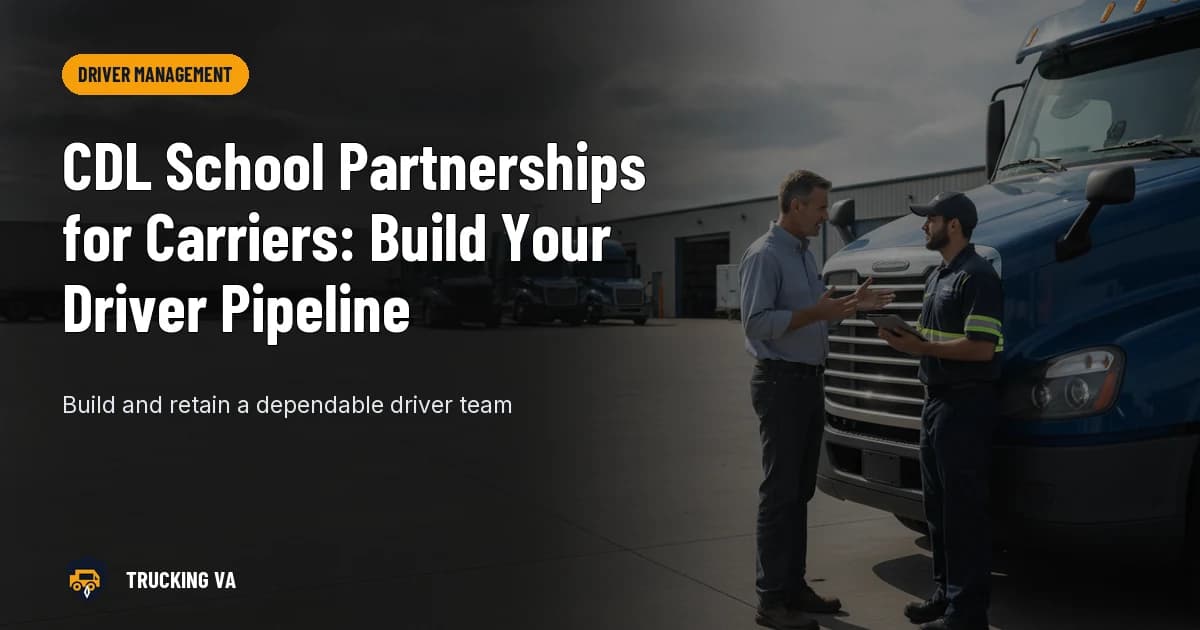
Understanding CDL School Partnerships for Carriers
The Federal Motor Carrier Safety Administration maintains a registered apprenticeship framework that allows carriers to formalize training relationships and create structured pipelines for new CDL holders entering the workforce. CDL school partnerships for carriers are formal or informal agreements between a trucking company and a licensed driving school that give the carrier early access to graduating students before those candidates start evaluating competitors. These partnerships are one of the most underutilized tools in carrier recruitment because most fleets wait for drivers to find them rather than building relationships upstream.
A well-structured school partnership means your company name, brand, and job offer are in front of students while they are still in training, before they have formed allegiances to other carriers. That early visibility is a significant competitive advantage in a market where qualified CDL candidates are in short supply. For a broader look at finding qualified applicants, see Cdl Driver Recruitment Tips as a companion to the school partnership strategy.
Why CDL School Partnerships for Carriers Matters
Building relationships with CDL schools gives carriers first access to new graduates before the broader recruiting market competes for their attention. Students who receive career support, mentorship promises, and a clear employment offer from a carrier they have come to know during training are far more likely to accept that offer than a cold outreach from a stranger.
School partnerships also enable carriers to influence the candidate pool over time. By engaging with students early, offering tuition reimbursement, and maintaining a visible presence at the school, carriers build a reputation that generates inbound interest from students who have not yet enrolled.
- Direct pipeline of trained, licensed drivers ready to hire on graduation day
- Lower recruiting costs compared to paid job boards or third-party recruiters
- First-mover advantage before competitors make their pitch to the same graduates
- Higher loyalty from drivers whose training was supported by your company
Key Considerations for CDL School Partnerships for Carriers
- Tuition Reimbursement Structure - Most successful programs reimburse $5,000 to $10,000 in training costs over 12 to 18 months of employment, creating a mutual commitment that benefits both the driver and the carrier.
- Placement Director Relationship - The school's placement director is the key contact who controls access to students, so investing in that relationship with regular visits and clear communication is essential.
- Formal Agreement Terms - Put the partnership in writing to clarify what the school provides (referrals, class access, materials display) and what the carrier offers (guaranteed interviews, reimbursement details, speaker opportunities).
- FMCSA Apprenticeship Registration - Carriers can register as apprenticeship sponsors with FMCSA, which opens access to structured training frameworks and may qualify them for federal wage subsidies or tax incentives.
- First-Year Training Program - Graduates need structured onboarding after hire, including mentored driving hours and a clear progression timeline, to convert from new hires into retained long-term employees.
Step-by-Step Approach
The first step in building a CDL school partnership is identifying schools within your operational geography whose graduates would be eligible to drive for your fleet. Focus on accredited programs with good graduation and licensing rates, as those graduates are more likely to pass background and MVR screening.
Once you have identified your target schools, the outreach process is straightforward but requires persistence and relationship-building over multiple contacts. A single email rarely converts into a formal partnership; carriers that succeed invest in face-to-face visits and consistent follow-through.
- Research CDL schools within 150 miles of your terminal or dominant freight lanes and evaluate their graduation and pass rates.
- Call the school's placement director and introduce your company, the types of freight you haul, and the employment benefits you offer graduates.
- Schedule an in-person visit to meet the staff, tour the facility, and understand what the school needs from a carrier partner.
- Offer to send a driver or recruiter to speak to current students about life at your carrier, pay structure, and what to expect in year one.
- Provide printed materials, branded items, or a career information board the school can display in common areas.
- Draft a formal partnership agreement that outlines both sides' commitments, including referral expectations, tuition reimbursement terms, and interview guarantees.
- Register your carrier as an apprenticeship sponsor with FMCSA to access structured training resources and potential financial benefits.
- Follow up with the placement director monthly, even when you are not actively hiring, to maintain the relationship for when you need it.
Common Mistakes to Avoid
Many carriers approach CDL schools only when they have open seats and disappear between hiring pushes. That inconsistency signals to school staff that the carrier is unreliable, and referrals will slow or stop entirely as a result.
Another common failure is offering tuition reimbursement without making the terms clear to students upfront. Complex clawback provisions, vague timelines, or inconsistent payment execution destroy trust and generate negative word-of-mouth within the school's student community.
- Making contact only during urgent hiring pushes rather than maintaining ongoing relationships
- Failing to follow through on tuition reimbursement payments as promised
- Sending generic materials that do not speak to new graduates' specific concerns about their first job
- Ignoring the first-year experience after hire, leading to early turnover that damages the school's willingness to refer future graduates
Numbers to Know
Industry benchmarks suggest that drivers hired through school partnerships and tuition reimbursement programs stay with a carrier 30 to 50% longer than drivers hired through open market advertising. The cost of the reimbursement is typically recovered within the first year through avoided recruiting and replacement costs.
CDL training programs at accredited schools typically run eight to twelve weeks, which means a carrier with an active school partnership has a predictable stream of candidates arriving on a regular cycle. Planning hiring around graduation schedules allows carriers to time offers and onboarding efficiently rather than reacting to turnover after it happens.
- Average CDL training cost ranges from $3,000 to $8,000 depending on school and program length
- Tuition reimbursement commitment commonly structured at $5,000 to $10,000 over 12 to 18 months of employment
- School-partnership hires show 30-50% longer average tenure compared to cold-market hires
- FMCSA-registered apprenticeship programs may qualify for federal training incentives worth up to $1,500 per apprentice
Next Steps
CDL school partnerships for carriers are a long-term strategy that compounds in value over time. The carriers with the strongest pipelines are the ones that invested in school relationships years before those relationships produced their first hire, and they continue to nurture those relationships even when their fleets are fully staffed.
To expand your pipeline further, explore How to Attract Cdl Drivers for additional sourcing strategies that complement school partnerships and give your carrier multiple channels for finding qualified candidates.
Building a school partnership program takes time, consistency, and follow-through, but the payoff in reduced recruiting costs and higher-quality hires is significant. If you want support setting up your carrier's CDL school outreach and partnership agreements, contact our team and we will help you build a pipeline that delivers results.