Understanding Cross Docking Trucking Operations
Cross docking is a logistics practice in which inbound freight is transferred directly from arriving trucks to outbound trucks with minimal or no storage time in between, and the Federal Motor Carrier Safety Administration reports that transportation networks using direct transfer models consistently reduce freight handling times and improve delivery cycle performance. Unlike traditional warehousing, where goods may sit in storage for days or weeks, cross docking is designed to keep freight in motion and eliminate the cost and delay associated with long-term inventory holding.
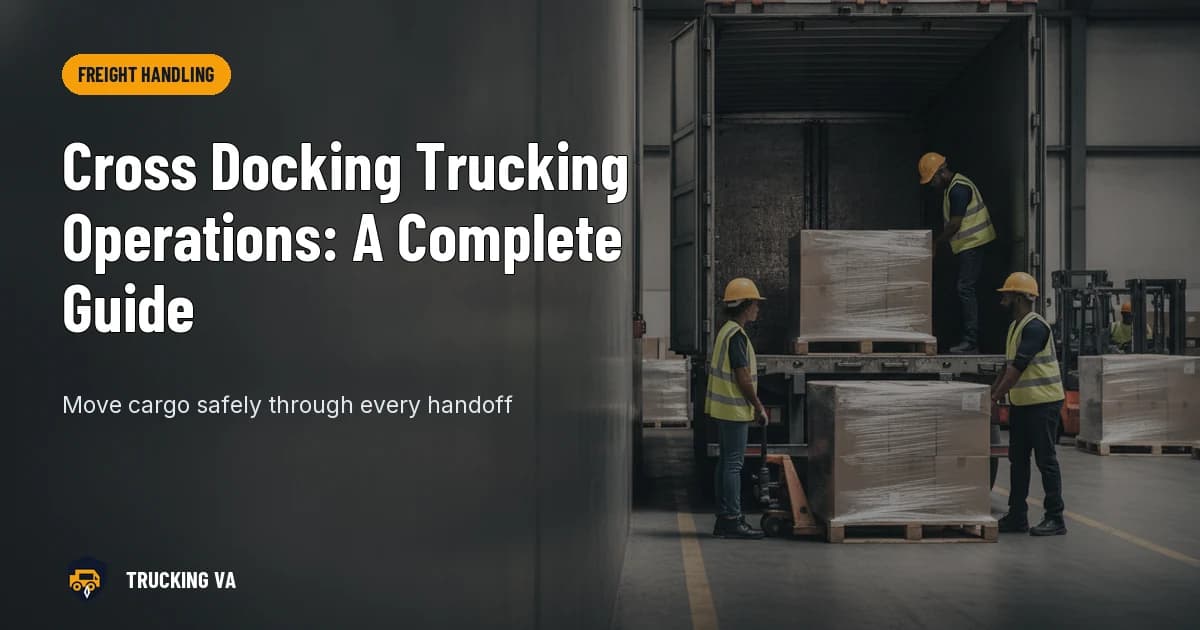
In a cross docking facility, trucks arrive at one side of the building, freight is unloaded onto the dock floor or a staging area, and then moved to waiting outbound trucks on the opposite side. The process can take as little as a few hours or extend to a day depending on freight volume, sorting requirements, and outbound load schedules.
There are several variations of cross docking, each suited to different supply chain needs. Pre-distribution cross docking handles freight that has already been sorted and labeled for specific destinations before it arrives at the facility, while post-distribution cross docking involves sorting at the facility itself based on outbound load consolidation requirements.
Retailers, grocery chains, automotive manufacturers, and e-commerce fulfillment operations are among the heaviest users of cross docking. These industries rely on high-velocity freight movement and cannot afford the carrying costs or delays that traditional warehousing introduces into their supply chains.
Cross docking is most effective when freight volumes are predictable, inbound and outbound schedules can be synchronized, and the products being transferred do not require storage, inspection, or repackaging at the facility. When those conditions are present, the model delivers significant speed and cost advantages over alternatives.
Carriers managing complex freight flows will find that cross docking aligns naturally with disciplined load planning. Our guide on Load Planning and Optimization covers the scheduling and consolidation strategies that make cross docking operations run efficiently.
Why Cross Docking Trucking Operations Matter
Cross docking eliminates one of the most expensive and time-consuming elements in a supply chain: warehouse storage. When freight moves from inbound truck to outbound truck in hours rather than days, the entire distribution network becomes faster and less expensive to operate.
The cost savings come from multiple directions simultaneously. Shippers pay less for warehousing space, carriers reduce dwell time at facilities, and end customers receive goods faster with fewer handling touches that could cause damage or loss.
- Transit Speed - removing warehouse dwell time from the supply chain can cut total transit time by one to two days on regional distribution routes
- Reduced Handling - every time freight is touched, there is risk of damage; cross docking minimizes touches by moving goods directly between transport vehicles
- Lower Storage Costs - eliminating intermediate storage removes the largest single line item in most distribution budgets, including rent, labor, and inventory carrying costs
- Fresher Product - for perishables, produce, and temperature-sensitive goods, faster transit time directly translates to longer shelf life and reduced spoilage at the destination
Key Considerations for Cross Docking Trucking Operations
- Schedule Synchronization - inbound and outbound trucks must arrive and depart on coordinated schedules; poor synchronization forces freight to wait on the dock floor, which undermines the core benefit of the model
- Facility Layout - an effective cross docking facility is designed with straight-through or T-shaped dock configurations that minimize the distance freight travels from unloading to loading
- Freight Compatibility - not all freight is suitable for cross docking; high-value, fragile, or hazardous goods may require special handling that slows the process or creates compliance requirements that make direct transfer impractical
- Technology Requirements - barcode scanning, RFID tracking, and warehouse management system integration are essential for ensuring that freight is routed to the correct outbound load without errors
- Staffing and Labor - dock labor must be skilled, available in flexible shifts, and capable of moving quickly during peak transfer windows when multiple trucks are loading and unloading simultaneously
Step-by-Step Approach
Setting up or optimizing a cross docking operation requires upfront planning around facility design, carrier coordination, and technology infrastructure. Jumping into cross docking without those foundations in place creates more chaos than efficiency.
Carriers and shippers who commit to the full implementation process are rewarded with a streamlined operation that compounds its efficiency gains as volume grows. Partial implementations that skip key steps tend to fail within the first few months.
- Map Your Freight Flows - document all inbound and outbound lanes, freight volumes, commodity types, and delivery windows to determine whether your freight profile is suited to cross docking
- Design or Evaluate the Facility - assess whether your existing dock has the layout, door count, and staging space to support simultaneous inbound and outbound operations without creating bottlenecks
- Synchronize Carrier Schedules - work with all inbound carriers to establish arrival windows that align with outbound departure times, building in buffer for typical delays
- Implement Freight Labeling Standards - require all inbound shipments to carry standardized labels that identify the outbound load, destination, and priority level before freight arrives at the facility
- Deploy a Dock Management System - use software that assigns doors, tracks inbound arrivals, manages staging locations, and triggers alerts when freight needs to be moved to an outbound truck
- Train Dock Labor - invest in cross-docking-specific training that covers safe freight handling, labeling verification, scanning procedures, and emergency protocols for misrouted freight
- Run a Pilot Program - before committing to full-scale cross docking operations, run a pilot on one lane or commodity type to identify process gaps and calibrate labor requirements
- Measure and Refine - track transfer time, dock utilization, error rate, and damage claims from the first day, and use that data to drive continuous improvement
Common Mistakes to Avoid
Cross docking failures almost always trace back to preventable operational errors rather than fundamental flaws in the model itself. Facilities that struggle with cross docking are usually dealing with one or more of the same recurring problems.
Identifying these mistakes before launch allows operators to build safeguards into their process design. Catching them after launch requires more disruptive corrective action.
- Scheduling inbound and outbound trucks without adequate buffer time for delays
- Failing to enforce freight labeling standards on inbound shipments before they arrive
- Understaffing the dock during peak transfer windows when multiple trucks are active simultaneously
- Skipping the pilot phase and attempting full-scale implementation before validating the process
Numbers to Know
Industry benchmarks for cross docking operations help facility managers set realistic targets and identify when their performance is lagging. These figures vary by freight type, facility size, and operational maturity.
Understanding where your operation stands relative to these benchmarks is the first step toward identifying improvement opportunities. Facilities performing well below these ranges are likely dealing with one of the common mistakes described above.
- 2 to 4 hours - target transfer time for pre-labeled freight in a well-run cross docking facility from inbound unload to outbound load
- 15% to 25% - typical reduction in distribution costs achieved by replacing traditional warehousing with cross docking on high-velocity lanes
- 3 to 5 dock doors per 10,000 square feet - standard dock door density for facilities designed specifically for cross docking operations
- Less than 1% - target freight error rate (wrong destination or misrouted load) for mature cross docking operations with full labeling and scanning compliance
Next Steps
Building a cross docking operation that consistently delivers its cost and speed promises requires disciplined execution across scheduling, technology, and labor management. The facilities that succeed are those that treat cross docking as an operational discipline, not just a facility layout choice.
Carriers who master cross docking gain a competitive advantage in lanes where speed and efficiency are the primary shipper priorities. Connecting your cross docking operation with strong dispatch systems compounds the benefit, and our Dispatch Software for Small Trucking Companies guide covers the tools that keep freight moving on both sides of the dock.
If your operation is looking to implement cross docking or improve an existing facility's performance, the Trucking VA team can provide the operational and administrative support you need to make the transition smooth and sustainable. Contact us today to discuss how we can help streamline your freight operations.