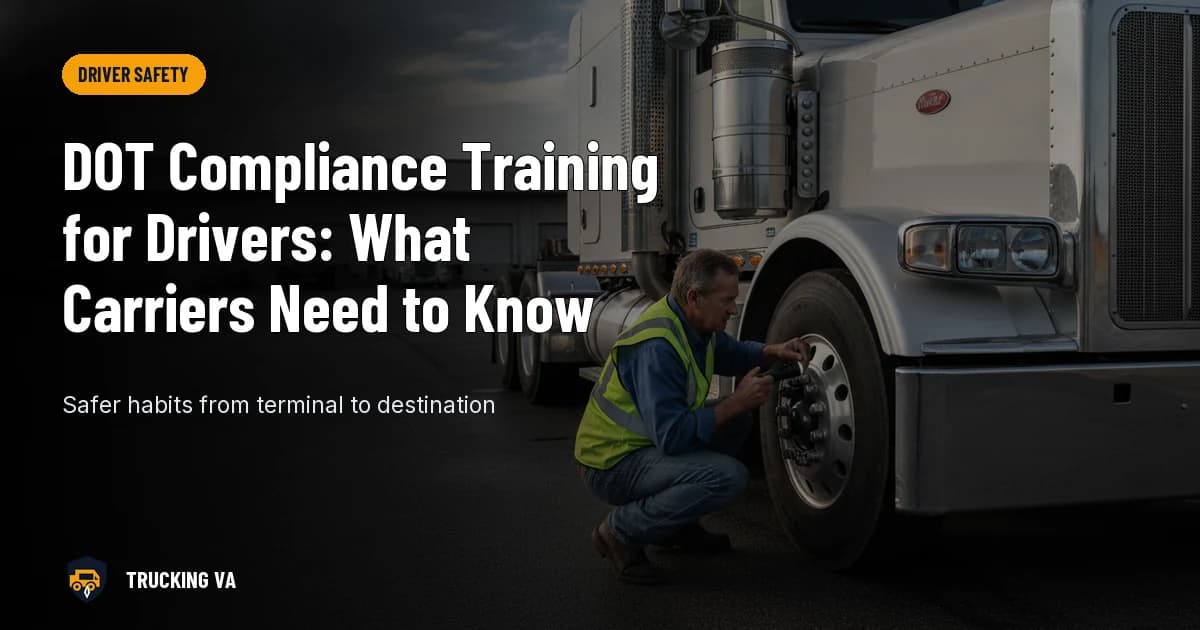
Understanding DOT Compliance Training for Drivers
The FMCSA reports that driver-related factors are a contributing cause in a significant share of large truck crashes each year, underscoring why DOT compliance training for drivers is one of the most important investments a carrier can make. Federal regulations require carriers to ensure their drivers are trained on specific topics before operating commercially, and the consequences of inadequate training extend well beyond fines. A carrier that cannot demonstrate documented training in the event of an accident faces amplified liability that no insurance policy can fully offset.
Since February 2022, FMCSA's Entry-Level Driver Training rule has required all new CDL applicants to complete training through a registered training provider before obtaining or upgrading their commercial license. This regulatory shift raised the baseline for what drivers must know before getting behind the wheel. See how training integrates with your full compliance program in Dot Compliance Checklist for Carriers.
Why DOT Compliance Training for Drivers Matters
Carriers with well-trained drivers consistently achieve better CSA scores, fewer roadside inspection violations, and lower accident rates. These outcomes translate directly into lower insurance premiums, stronger relationships with brokers and shippers, and fewer interruptions to revenue-generating operations.
Training is also a legal shield. When a carrier can produce documented proof that a driver was trained on a relevant topic before an incident occurred, it fundamentally changes how regulators and courts assess liability. Without that documentation, the carrier is exposed to the assumption that training never happened.
- Reduces out-of-service violations during roadside inspections and compliance reviews
- Lowers accident frequency and severity across the fleet
- Protects the carrier from regulatory penalties during DOT audits
- Demonstrates due diligence to insurers, shippers, and freight brokers
Key Considerations for DOT Compliance Training for Drivers
- Hours of Service Regulations - Every driver must be trained on 49 CFR Part 395, including how to accurately record duty status using an ELD, manage exemptions, and avoid violations that generate CSA points.
- Pre-Trip and Post-Trip Inspections - Drivers must be trained to conduct systematic vehicle inspections before and after every trip, identifying defects that could result in an out-of-service order or a preventable accident.
- Drug and Alcohol Awareness - Training under 49 CFR Part 382 must cover prohibited substances, testing circumstances, the consequences of a positive result, and how drivers can seek help before a violation occurs.
- Hazardous Materials Handling - Drivers who transport hazardous materials must complete training under 49 CFR Parts 171-180 covering proper placarding, emergency response, and loading and segregation requirements.
- ELD Malfunction Procedures - Drivers must know the federally required steps to take when an ELD malfunctions, including how to maintain paper logs and notify their carrier within 24 hours of the malfunction.
Step-by-Step Approach
Building an effective DOT compliance training program requires more than simply presenting drivers with information. The training must be delivered by qualified instructors or registered providers, documented in the driver qualification file, and refreshed as regulations change.
Carriers who approach training systematically rather than reactively will find that it becomes a competitive advantage rather than a compliance burden. A driver who understands the regulations is faster to resolve roadside issues, less likely to generate violations, and more confident in high-pressure situations.
- Audit your current driver qualification files to identify which training topics are already documented and which are missing or outdated.
- Map each required training topic to the corresponding federal regulation, so you can demonstrate the regulatory basis for each element of your program.
- Identify whether your training will be delivered internally by a qualified person, through a third-party compliance training provider, or through an FMCSA-registered training organization for ELDT requirements.
- Schedule training sessions for all new drivers during onboarding, before they are assigned to any revenue-generating load.
- Deliver training on hours of service, vehicle inspections, drug and alcohol awareness, ELD operation, accident reporting, and any hazmat topics applicable to your freight type.
- Collect signed acknowledgment forms from each driver confirming they received and understood each training topic.
- File all training documentation, including the date, topic covered, trainer name, and driver signature, in the driver qualification file maintained for each individual.
- Schedule recurring refresher training at least annually and any time a regulatory change affects driver responsibilities.
Common Mistakes to Avoid
Many carriers treat driver training as a one-time onboarding event rather than an ongoing program. This approach creates gaps in documentation and leaves drivers operating with outdated knowledge as regulations evolve.
Another common failure is delivering training informally without generating any documentation. A verbal safety briefing or a group meeting with no sign-in sheet provides zero protection during a DOT audit or post-accident investigation.
- Failing to document training with signed acknowledgment forms and specific topic records
- Relying on drivers to self-certify completion of online training without verification of understanding
- Not updating training content when FMCSA issues new regulations or changes existing rules
- Skipping hazmat training for drivers who occasionally handle hazardous materials due to incorrect assumptions about frequency thresholds
Numbers to Know
Federal regulations establish specific timelines and thresholds that define when training is required and who must deliver it. Knowing these numbers helps carriers structure their programs around what regulators actually require rather than guesswork.
These benchmarks also highlight how costly it is to fall behind on training requirements, as the cost of a single violation or accident far exceeds the investment in a properly structured training program.
- FMCSA's Entry-Level Driver Training rule, effective February 7, 2022, requires all new CDL applicants to complete training from a provider listed in the Training Provider Registry before taking a skills test
- Hazardous materials training must be completed within 90 days of employment for a driver who will handle hazmat, and refresher training is required every 3 years under 49 CFR Part 172.704
- Carriers with a Satisfactory safety rating following a compliance review demonstrate training documentation as a key factor in achieving that rating
- A single Driver Out-of-Service violation during a roadside inspection contributes to a carrier's unsafe driving or hours-of-service BASIC score, affecting SMS percentile rankings visible to shippers and brokers
Next Steps
DOT compliance training for drivers is not a checkbox exercise. It is a continuous program that requires structure, documentation, and regular updates to remain effective and legally defensible.
Building your training program on a documented framework protects your drivers, your business, and your operating authority against regulatory and legal challenges. Carriers who invest in systematic training consistently outperform their peers on safety metrics that directly affect revenue. See how to set drivers up for success from day one in Truck Driver Onboarding Best Practices.
If managing driver training documentation and compliance records is stretching your administrative capacity, we can help. Contact our team today to learn how a trucking virtual assistant can track driver training deadlines, maintain qualification files, and keep your compliance program running without gaps.