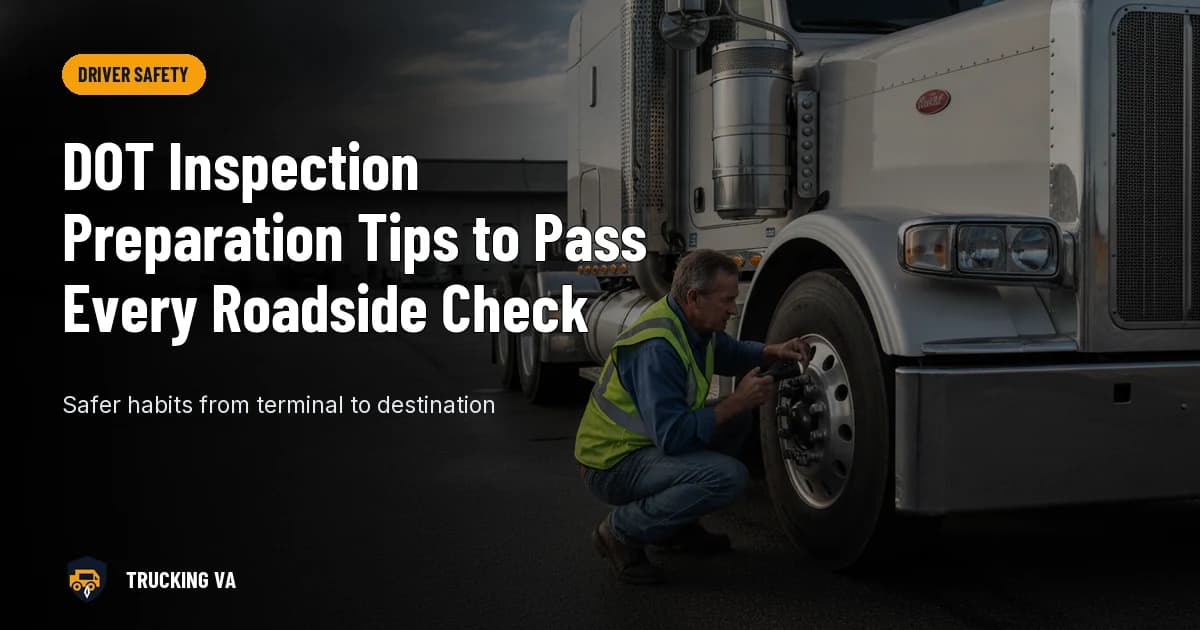
Understanding DOT Inspection Preparation
DOT inspection preparation refers to the ongoing operational practices, driver training, and equipment maintenance routines that a carrier implements to ensure their trucks and drivers consistently pass Commercial Vehicle Safety Alliance roadside inspections without generating violations that affect the carrier's CSA score and safety record.
The Commercial Vehicle Safety Alliance administers seven levels of roadside inspection ranging from a full inspection of driver, vehicle, and cargo (Level I) to a cursory review of license plate and credential records (Level VI). Level I and Level II inspections are the most common and the most consequential, examining driver credentials, hours of service records, vehicle mechanical condition, and cargo securement.
Roadside inspections are not random in the way the term implies. The FMCSA's Compliance, Safety, and Accountability system uses a carrier's historical inspection violation data to assign BASIC scores in seven safety categories. Carriers with elevated BASIC scores are flagged in inspection targeting systems that direct enforcement officers to prioritize their trucks for inspection. Better scores mean fewer inspection triggers.
Preparation is not about gaming the inspection system. It is about maintaining the mechanical condition, documentation accuracy, and driver compliance that inspections are designed to verify. A carrier whose trucks genuinely meet all regulatory requirements has nothing to fear from any inspection and can approach each one as an opportunity to demonstrate their safety commitment.
Understanding the inspection process from the officer's perspective helps carriers prepare more effectively. Inspectors follow a defined checklist developed by the CVSA, and knowing which items receive the most scrutiny allows carriers to prioritize those areas in their preparation programs.
Inspection readiness connects to the complete compliance management framework that protects your operation. Our guide on Commercial Vehicle Inspection Checklist provides the item-by-item inspection reference that drivers need for daily pre-trip inspections.
Why DOT Inspection Preparation Tips Matter
Every violation found during a roadside inspection is recorded in the FMCSA database and contributes to the carrier's BASIC scores for 24 months from the date of violation. Violations in the Unsafe Driving, Hours of Service Compliance, Driver Fitness, Controlled Substances, Vehicle Maintenance, and Cargo Securement BASICs all affect specific score categories that shippers and brokers review when qualifying carriers.
Out-of-service orders are the most immediate consequence of a failed inspection. A truck placed out of service during a roadside inspection cannot continue until the identified defect is repaired and the truck is released by an inspector. The revenue lost during an unexpected out-of-service situation compounds with the repair cost and any expedited shipping costs needed to cover the load.
Carrier reputation among enforcement agencies is also shaped by inspection history. Carriers whose trucks consistently pass inspections without violations are often subject to fewer future stops as enforcement targeting systems identify low-risk carriers. Carriers with frequent violations face increased inspection frequency that amplifies the operational disruption.
Driver confidence also benefits from thorough inspection preparation. Drivers who know their trucks are in excellent mechanical condition and who are confident in their documentation accuracy approach inspections calmly and professionally, which creates a more positive interaction with inspectors than stressed or uncertain drivers who project anxiety about what the inspector might find.
The proactive cost of maintaining compliance through rigorous preparation is always less than the reactive cost of managing violations, out-of-service orders, and CSA score recovery programs that result from inadequate preparation.
Key Considerations for DOT Inspection Preparation Tips
- Pre-Trip Inspection Quality - A thorough, consistent pre-trip inspection by the driver before every dispatch is the most direct form of inspection preparation because it identifies defects before the truck reaches a scale house.
- Brake System Priority - Brakes are the single most common out-of-service violation category; brake adjustment, lining thickness, and air system integrity deserve extra attention in every pre-trip inspection.
- Tire Condition and Inflation - Underinflated tires, tires with insufficient tread depth, and tires with visible sidewall damage are common inspection violations that a daily tire check would prevent.
- Lighting Systems - All required lights including brake lights, turn signals, marker lights, and headlights must be functioning for every dispatch; a quick lighting check takes two minutes and prevents a common violation category.
- Driver Documentation - The driver's CDL, medical certificate, and registration documents must be current, valid, and immediately accessible during any inspection stop.
- HOS Record Accuracy - ELD records must accurately reflect the driver's actual duty status history; any discrepancy between ELD data and the driver's actual activities creates a violation that is both a compliance failure and evidence of intentional manipulation.
Step-by-Step Approach
Building a DOT inspection preparation program requires both driver training and operational systems that create consistent compliance readiness across the fleet every day, not just in advance of anticipated inspections.
-
Review your carrier's current CSA scores in the FMCSA Safety Measurement System and identify which BASIC categories have the highest violation concentration. This analysis reveals which inspection item categories are generating the most frequent violations and should receive the highest preparation priority.
-
Conduct a shop inspection of every truck in your fleet and compare the findings against the CVSA inspection criteria for Level I inspections. Document any items that would generate a violation finding and address them before those trucks return to service.
-
Deliver a driver inspection preparation training session that walks through each item on the CVSA Level I checklist and demonstrates both what each item requires to pass and what a failing condition looks like. Drivers who have seen a failing brake adjustment or a cracked tire sidewall before an inspection recognize the same conditions when conducting their own pre-trip checks.
-
Implement a daily lighting systems check as a mandatory step in every driver's pre-trip routine. Have a second person confirm that all rear lights are functioning while the driver operates brake pedal, turn signals, and marker light switches from the cab.
-
Establish a brake measurement program that checks and records brake adjustment and lining thickness for every truck at each periodic maintenance service and records the measurements in the maintenance log. Documented brake service history provides evidence of maintenance diligence if a brake violation is cited during an inspection.
-
Confirm that every driver carries their CDL, current medical certificate, registration documents, and insurance certificate in an immediately accessible location in the cab. A driver who must search through the cab for required documents during an inspection creates an unfavorable first impression that sometimes motivates more thorough scrutiny.
-
Audit your ELD records monthly for accuracy and completeness. Review a sample of ELD data against the driver's known schedule to confirm that duty status transitions are being recorded correctly and that driving time is not being logged as off-duty to reduce apparent HOS violations.
-
Create a vehicle defect reporting and repair tracking system that closes the loop between driver-reported defects and documented repair completion. FMCSA requires that defects reported on DVIRs be repaired and certified before the vehicle returns to service; this documentation is reviewed during compliance inspections.
Common Mistakes to Avoid
The most damaging inspection preparation mistake is treating pre-trip inspections as a signature exercise rather than a genuine mechanical evaluation. Drivers who sign blank or pre-filled DVIRs without actually conducting the inspection lose the early defect detection benefit that pre-trip inspections provide and create fraudulent documentation that increases liability exposure in accidents.
Deferring minor defect repairs to the next scheduled maintenance visit is a second mistake that creates inspection violations from conditions that would have been prevented by immediate repair. Burnt-out marker lights, loose conspicuity tape, and minor brake adjustments are all conditions that generate violations at scale house stops when they could be addressed in minutes at the yard.
Relying on periodic inspections to be the only vehicle condition check rather than treating them as the backup to daily driver inspections is a third preparation failure. Annual or semi-annual shop inspections cannot compensate for the defect detection gap that exists when daily pre-trips are not conducted properly.
- Failing to confirm driver documentation validity before dispatch, discovering an expired medical certificate only after the driver is stopped at a scale
- Not reviewing CSA score data monthly to identify trending violation categories that signal a systemic preparation failure rather than isolated individual incidents
- Conducting inspection preparation training only during driver orientation and then never revisiting the material as regulations change or as the fleet's specific violation patterns evolve
- Ignoring the cargo securement requirements for specialty freight types when drivers occasionally haul flatbed, oversized, or liquid bulk loads outside their normal freight specialty
Numbers to Know
The quantitative relationship between inspection preparation quality and CSA score performance provides compelling evidence for investing in structured preparation programs. These benchmarks reflect the difference in outcomes between carriers with rigorous preparation programs and those relying on informal compliance management.
The financial impact of reduced out-of-service orders, lower CSA scores, and reduced insurance premiums creates a measurable return on the investment in inspection preparation infrastructure that most carriers can recover within a single operating year.
Understanding these numbers also helps carriers communicate the business case for inspection preparation investment to owners and managers who may view compliance activities as overhead rather than revenue protection.
- CVSA data shows that brake system violations account for approximately 28 percent of all vehicle out-of-service violations during roadside inspections, making brake maintenance the single highest-priority mechanical preparation focus for any fleet
- Carriers whose CSA scores fall below the investigation threshold in all seven BASICs experience on average 30 to 40 percent fewer roadside inspection stops per million miles than carriers with scores above the threshold, according to FMCSA enforcement targeting data
- The average revenue loss from a truck placed out of service during a roadside inspection, including lost loads, emergency repair costs, and towing fees, ranges from $1,500 to $8,000 per incident depending on the defect type and geographic location
- Carriers who implement formal driver inspection training programs report inspection pass rates 15 to 25 percentage points higher than carriers without formal training, based on comparative data from carrier safety management programs
Next Steps
You now have a comprehensive framework for DOT inspection preparation that addresses both the mechanical condition and documentation components that determine inspection outcomes. The immediate next step is to pull your CSA scores and identify the violation categories where your fleet is generating the most frequent findings.
For each high-frequency violation category, trace the root cause back to either driver training gaps, equipment maintenance failures, or process deficiencies. Each root cause requires a different intervention, and addressing the wrong cause will not reduce the violation rate.
Consistent inspection performance also depends on the vehicle maintenance program that keeps trucks in compliant condition between inspections. Our resource on DOT Compliance Checklist for Carriers provides the complete compliance framework that inspection preparation fits into as one component.
Ready to build an inspection preparation program that protects your CSA score and keeps your trucks on the road? Visit our contact page to speak with a compliance specialist who can assess your current inspection performance and design a targeted improvement program.