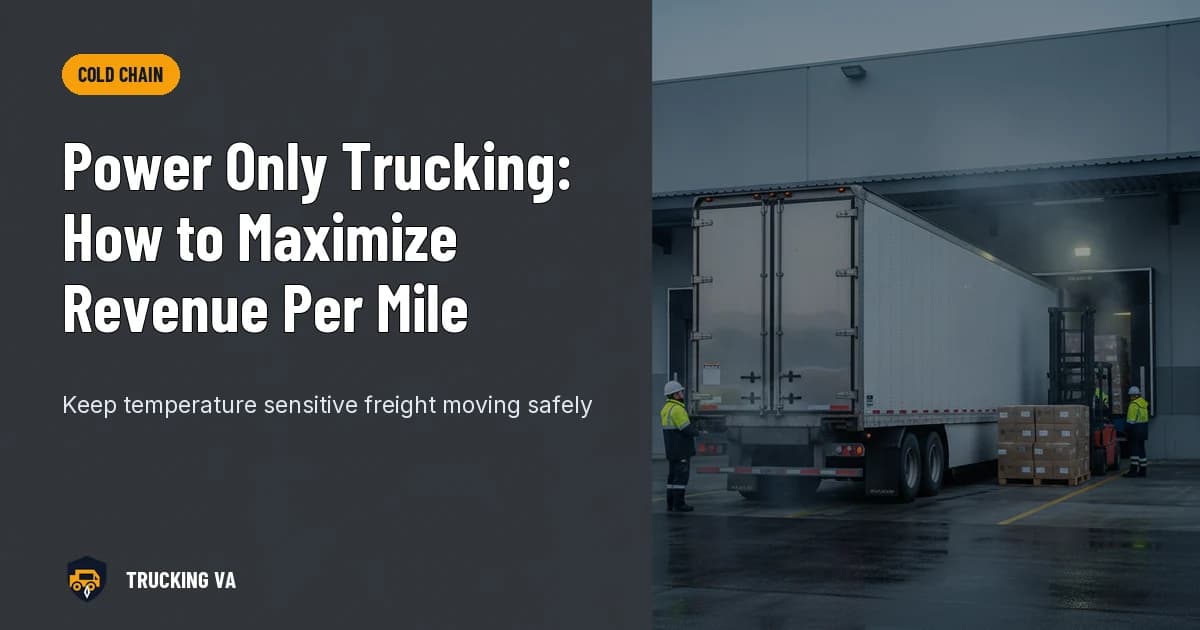
Understanding Power Only Trucking
According to FMCSA carrier registration data, the vast majority of registered motor carriers operate small fleets where capital allocation decisions, such as whether to invest in trailers, have an outsized impact on profitability. Power only trucking is a freight model where the carrier provides only the tractor, while the trailer is owned by the shipper, retailer, or a third-party trailer pool company. This arrangement shifts the cost and maintenance burden of trailer ownership off the carrier while still generating revenue on every loaded mile.
The power only model has grown significantly as major retailers and e-commerce companies have built their own trailer pools to maintain more control over their supply chains. Carriers who understand how to access and navigate these freight networks can build stable, high-volume lane structures without a dollar invested in trailers. Understanding your load options across all freight types helps you select the right niche, as explored in How to Find Truck Loads Online.
Why Power Only Trucking Matters
Trailers represent a substantial capital investment, with new 53-foot dry van trailers costing between $30,000 and $50,000 or more, depending on spec and market conditions. A carrier who can generate revenue without owning trailers preserves that capital for fuel, maintenance, insurance, and driver pay, all of which have a more direct impact on daily operations.
Beyond the capital benefit, power only freight often moves as drop-and-hook, meaning the driver backs under a pre-loaded trailer and immediately departs. This eliminates detention time at shippers and receivers, which is one of the largest sources of unpaid waiting time in conventional van operations.
- Eliminates the capital cost of trailer purchase, registration, and maintenance
- Reduces driver detention because drop-and-hook moves are pre-staged by the shipper
- Creates access to high-volume freight networks operated by major retailers and logistics companies
- Allows flexibility to haul different trailer configurations as loads require
Key Considerations for Power Only Trucking
- Trailer Interchange Insurance - Carriers operating power only must carry trailer interchange coverage, which protects the carrier if a non-owned trailer is damaged while in their possession; this is separate from standard cargo and liability policies.
- Fifth Wheel and Connection Equipment - The tractor must have a properly sized and maintained fifth wheel to accept standard 53-foot trailers, and drivers must be trained on connection procedures for different trailer types.
- Trailer Type Familiarity - Power only loads may involve dry van trailers, refrigerated units, flatbeds, or specialty configurations, so drivers should be comfortable operating with trailer types they will encounter in their assigned lanes.
- Broker and Shipper Relationships - Many power only loads are available through dedicated shipper programs with specific carriers, making direct relationships with high-volume shippers more valuable than standard spot market access.
- Load Board Access - DAT and Truckstop both maintain dedicated power only load categories that allow carriers to filter specifically for these opportunities, which is distinct from searching the general dry van or flatbed markets.
Step-by-Step Approach
Entering the power only market requires a deliberate setup process that differs from standard van or flatbed operations. Carriers who jump in without the right insurance and equipment configuration often encounter problems at the shipper facility that delay their first loads.
Once you are properly set up, building volume in power only freight depends on lane consistency and reliability. Shippers with large trailer pools prioritize carriers who show up on time and return trailers promptly, so operational discipline is a competitive advantage in this niche.
- Verify that your tractor's fifth wheel is compatible with and properly maintained for use with standard 53-foot dry van trailers, which are the most common trailer type in power only programs.
- Contact your insurance broker to add trailer interchange coverage to your policy, specifying the maximum trailer value you expect to haul to ensure adequate coverage limits.
- Register accounts on DAT and Truckstop and configure your search filters to show power only loads in your target lanes and geographic regions.
- Research which major shippers, third-party logistics companies, and trailer pool operators have active programs in your region, including Amazon's relay network, Walmart, Home Depot, and similar high-volume retailers.
- Apply directly to dedicated carrier programs where available, as these often offer consistent lane commitments with predictable rates rather than spot market variability.
- Complete any required carrier qualification or onboarding steps for shipper programs, including safety rating verification, insurance certificate submission, and driver background check authorization.
- Execute your first loads with careful attention to trailer pickup and drop procedures, documenting trailer condition at pickup to protect against damage claims.
- Track revenue per mile, detention time, and deadhead percentages for your power only lanes and compare them against your other freight types to guide future lane selection decisions.
Common Mistakes to Avoid
Carriers entering power only trucking often underestimate the insurance requirement and discover the gap only when they arrive at a shipper facility and are turned away for not having trailer interchange coverage. Resolving an insurance gap in the field is costly and disruptive.
Another frequent mistake is treating power only loads exactly like conventional van loads without accounting for the drop-and-hook discipline that shipper programs require. Returning trailers late or dropping them at incorrect locations creates relationship problems that can result in removal from a program.
- Operating without trailer interchange insurance and assuming cargo or physical damage coverage fills the gap
- Failing to inspect and document trailer condition at pickup, leaving the carrier exposed to pre-existing damage claims
- Neglecting to verify that the trailer connection is secure before leaving the shipper facility
- Treating power only lane commitments casually and missing pickup appointments that damage standing in high-volume programs
Numbers to Know
Power only trucking has specific financial and operational benchmarks that help carriers evaluate whether a load is worth accepting and how it compares to other freight options. Understanding these numbers allows for better dispatching decisions and rate negotiation.
These figures also illustrate why power only has attracted attention from small and mid-size carriers as a way to increase revenue without increasing equipment debt.
- Power only loads frequently pay $0.05 to $0.15 per mile more than equivalent dry van loads on the same lane, reflecting the shipper's savings on trailer cost and staging
- New 53-foot dry van trailers cost between $30,000 and $50,000 each, meaning a carrier avoiding trailer ownership preserves significant working capital per unit
- Trailer interchange insurance typically adds $50 to $150 per month to a carrier's insurance premium, a modest cost relative to the revenue opportunity
- Drop-and-hook power only moves can reduce driver time at a shipper or receiver by two to four hours compared to live load and unload operations, improving daily productivity
Next Steps
Power only trucking is a proven model for carriers who want to increase revenue per mile without taking on the overhead of trailer ownership and maintenance. The key is setting up your operation correctly from the start, with the right insurance, the right equipment configuration, and access to the right freight networks.
As you build volume in power only lanes, you will develop a clearer picture of which shippers and corridors produce the most consistent and profitable freight. That data becomes the foundation for a dedicated lane strategy that reduces volatility and improves planning across your fleet. Learn how to apply that thinking to the spot market alongside dedicated freight in Spot Freight Market Strategies.
If you need support identifying power only opportunities, managing broker relationships, or handling the administrative side of your freight operations, our team is ready to assist. Contact us today to learn how a trucking virtual assistant can help you find and book more power only loads without adding back-office headcount.