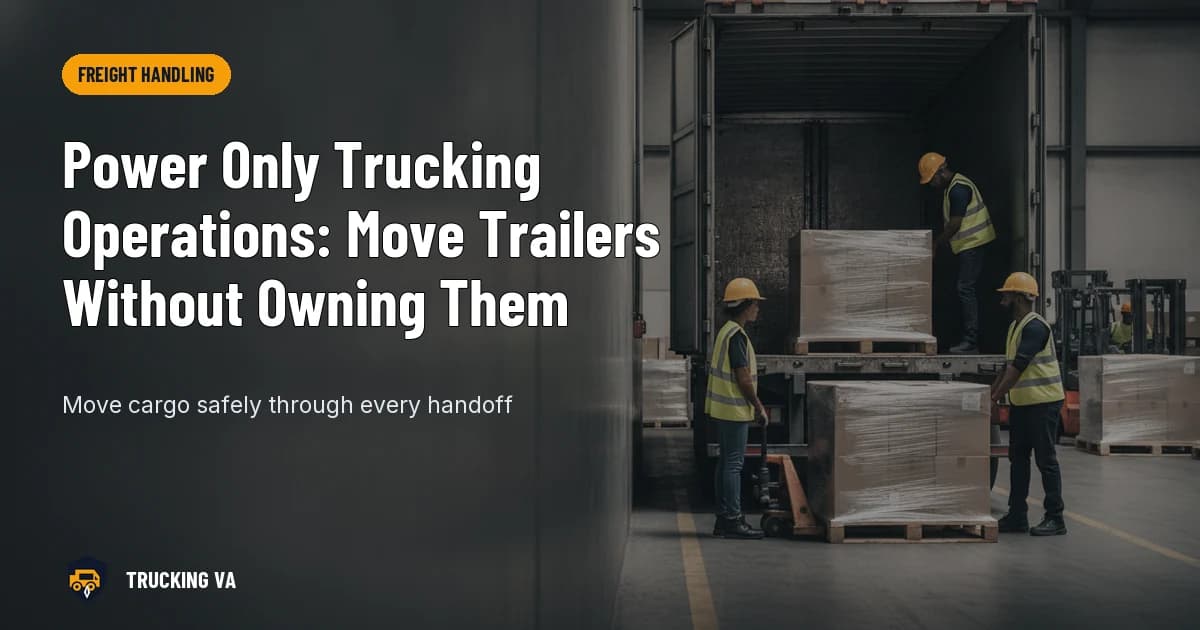
Understanding Power Only Trucking Operations
Power only trucking operations involve a tractor-only carrier connecting to and moving trailers owned by shippers, retailers, brokers, or trailer leasing companies, rather than providing the trailer as part of the service. The carrier's tractor provides the motive power while the customer provides the trailer, creating a freight service model where the carrier's capital investment is limited to the tractor and where trailer availability, maintenance, and liability rest with the trailer owner. This model has become increasingly common in domestic freight markets as large retailers, manufacturers, and logistics companies maintain their own trailer fleets and need carriers who can move those trailers efficiently.
According to the American Trucking Associations, power only operations have grown as large shipper trailer fleets have expanded, particularly among major retailers who operate trailer pools at distribution centers and need carrier tractor capacity to move trailers without the carrier providing additional trailer inventory. This growth creates a viable freight specialization for carriers who want to minimize equipment investment while maximizing tractor utilization across a well-paying freight niche.
Power only operations require carriers to understand trailer inspection responsibilities, cargo liability boundaries when they do not own the cargo container, rate structures that reflect the different cost model of tractor-only service, and the specific customer types and freight platforms where power only loads are available. The operational model differs from traditional van operations in ways that affect compliance, insurance, and customer interaction that carriers must understand before entering this market. Our guide on Drop and Hook Freight Operations covers the related operational model that power only frequently produces in practice.
Why Power Only Trucking Operations Matters
Capital efficiency is the primary financial advantage of power only operations. A carrier who provides only the tractor avoids the $25,000 to $50,000 or more per trailer investment that traditional van operations require, reducing the capital deployed per revenue-generating unit and improving return on invested capital at equivalent revenue levels. For owner-operators and small carriers where capital access is limited, power only provides a path to competitive earnings without the trailer fleet investment that constrains entry into standard van operations.
Trailer maintenance elimination is the operational advantage that follows from the capital efficiency of power only. Trailer maintenance, DOT trailer inspections, trailer tire management, and trailer damage tracking are all the trailer owner's responsibility in power only arrangements. The carrier's maintenance burden is limited to the tractor, simplifying maintenance planning and eliminating the administrative overhead of trailer fleet management.
Rate structures for power only freight frequently reflect the specialized nature of the service. Power only loads available through broker load boards and direct shipper relationships often pay at or above dry van rates because fewer carriers have the operational understanding, insurance configuration, and equipment to serve the market effectively. Carriers who develop power only expertise and reliable relationships in this market can achieve rate outcomes that generalist van carriers cannot access.
- Equipment cost reduction - Tractor-only operation eliminates trailer investment costs while maintaining the revenue potential of a full truckload service.
- Trailer maintenance elimination - When the customer owns the trailer, the maintenance burden, DOT inspection compliance, and damage tracking belong to the trailer owner rather than the carrier.
- Specialized market access - Power only freight served by fewer qualified carriers often commands rate premiums above comparable dry van loads.
- Operational simplicity - A carrier managing only tractor equipment has simpler maintenance, insurance, and operational requirements than a carrier managing a mixed tractor-trailer fleet.
Key Considerations for Truck Driver Trucking Operations
- Pre-Trip Inspection Responsibility - When connecting to a customer-owned trailer, the driver is responsible for pre-trip inspection of the trailer and for documenting any pre-existing damage before accepting the connection; this documentation protects the carrier from liability for damage that occurred before their custody.
- Cargo Liability Boundaries - In power only operations, the cargo liability structure depends on the contract terms; carriers should confirm whether their cargo insurance covers freight in customer-owned trailers and whether the trailer owner's cargo insurance provides primary coverage.
- Insurance Configuration - Standard trucking insurance policies may need specific endorsements or coverage adjustments for power only operations where the carrier does not own the trailer being pulled; confirm with your insurance broker that your policy covers power only operations.
- Rate Structure Clarity - Power only rates may be quoted per mile, per load, or as a line-haul amount without separate trailer rental; ensure the rate structure for each load reflects the actual service being provided.
- FMCSA Trailer Requirement - While the carrier does not own the trailer, the FMCSA trip inspection requirements still apply; the driver must inspect and accept the trailer condition before moving it.
Step-by-Step Approach
Entering power only trucking operations requires confirming insurance coverage, identifying the appropriate load sources, and establishing the pre-trip inspection and documentation protocols that protect the carrier from trailer damage liability.
-
Review your current commercial trucking insurance with your broker to confirm that it covers operations where you are pulling customer-owned trailers. Some standard policies have exclusions or coverage limitations for non-owned trailers that must be addressed with specific endorsements.
-
Update your equipment authority registration with FMCSA if necessary to ensure your operating authority covers the tractor-only operating model that power only represents. Most standard property carrier authority covers this model, but verify before beginning operations.
-
Develop the pre-trip inspection documentation protocol for customer-owned trailers, including a condition checklist that the driver completes at pickup noting any pre-existing damage, and the process for communicating damage findings to the shipper or trailer owner before the trailer is moved.
-
Research the load sources for power only freight in your operating lanes. Major load boards including DAT and Truckstop have power only search filters; shipper direct power only opportunities come from major retailers, manufacturers with trailer pools, and logistics companies that manage trailer fleets.
-
Build relationships with brokers who specialize in power only freight or who serve shippers with large trailer pools. Brokers who understand power only operations will have repeat opportunities in the specific lanes where trailer pools generate consistent demand.
-
Establish cargo documentation review as part of every load acceptance process, confirming what commodity is in the trailer before accepting custody and verifying that the cargo matches the load documentation provided by the shipper or broker.
-
Define driver protocols for discovering trailer mechanical issues, flat tires, or damage during transit, including who is contacted first (broker vs. shipper), how the carrier documents the discovery, and what the driver does while waiting for repair authorization from the trailer owner.
-
Track power only load history separately from van loads in your TMS to analyze rate trends, lane performance, and the volume of power only freight available from your best broker and shipper relationships.
Common Mistakes to Avoid
The most consequential power only mistake is connecting to and moving a damaged trailer without documenting pre-existing damage at the time of connection. When a trailer is returned with damage that the carrier claims was pre-existing, the absence of condition documentation at pickup creates the carrier's liability for damage they did not cause.
Assuming that your standard cargo insurance covers freight in non-owned trailers without verifying this with your insurance broker is an error that can leave a carrier uninsured for cargo claims on power only loads.
- Moving a trailer before completing a pre-trip inspection because of time pressure at the shipper dock, accepting mechanical defects or safety issues that should have been documented and addressed before pulling the trailer
- Not researching whether your specific state or operating jurisdictions have any regulatory requirements specific to pulling non-owned trailers that differ from standard tractor-trailer operation
- Accepting power only loads on platforms that typically serve dry van and not verifying the load is actually power only before dispatching without a trailer, arriving at a shipper who expects the carrier to provide the trailer
- Not building the power only pre-trip inspection protocol into driver training and orientation, leaving drivers to develop inconsistent individual practices that do not protect the carrier adequately
Next Steps
If your trucking operation has tractors that could be generating revenue moving customer trailers without the capital investment of additional trailer acquisition, power only operations represent an available market that fewer carriers compete for effectively. The first step is confirming that your insurance covers non-owned trailer operations and identifying the load board filters and broker contacts that connect you to power only freight in your primary lanes.
After the operational framework is established, building the pre-trip documentation discipline and developing relationships with brokers who specialize in power only freight creates a sustainable lane in this specialized market. For carriers whose primary operation is traditional van freight, power only can be an opportunistic complement that fills tractor availability gaps without requiring additional equipment. Our guide on Freight Rate Negotiation Tips covers rate strategies that apply directly to power only freight negotiations.
Ready to explore power only trucking as a capital-efficient freight revenue opportunity for your tractor fleet? Contact our team at /contact to discuss freight operations strategy and support for carriers building into specialized markets.