Key takeaways
- A location observation has a confidence level and an age; it is not automatically a live location.
- Dwell requires two comparable events and a defined stop or custody boundary.
- A reconciled exception queue can improve visibility without turning clerical evidence into a maintenance or safety decision.
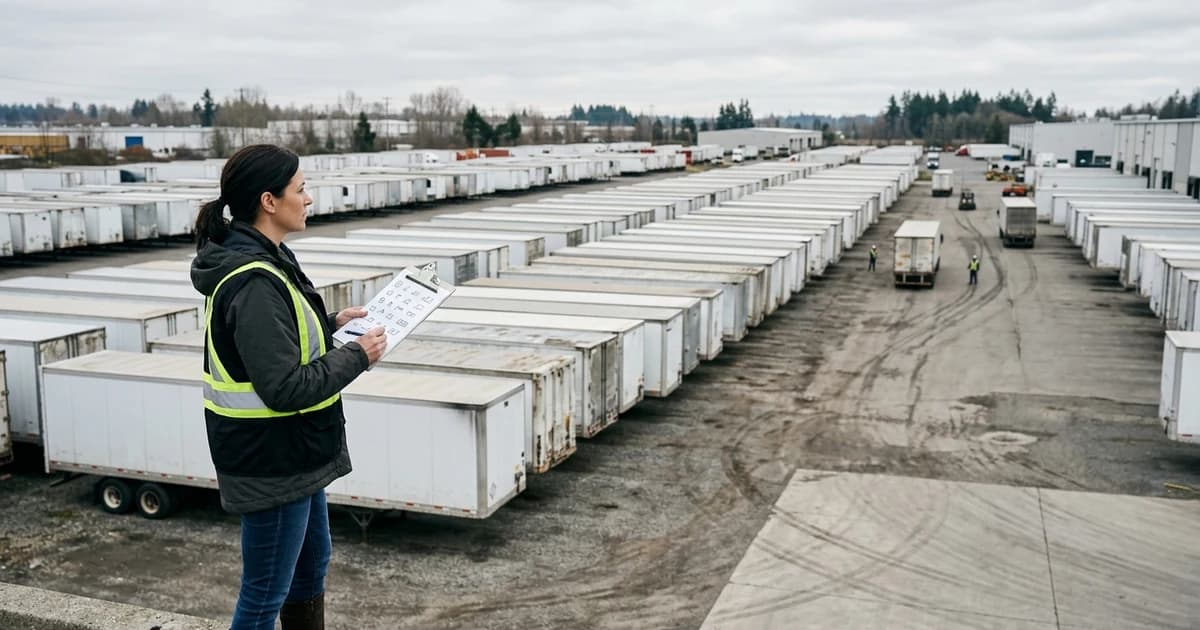
How long does a trailer remain unavailable when nobody has a continuous location feed? That question is more useful than asking whether a trailer is “tracked.” Many small and mid-sized trucking operations assemble location evidence from dispatch notes, interchange records, gate events, bills of lading, maintenance entries, and occasional telematics pings. The research problem is to measure dwell without presenting a stale observation as certainty.
Scope and method
The review uses public freight-measurement guidance, transportation statistics, ELD documentation, and NIST uncertainty guidance. It studies records rather than a specific fleet. The unit is a trailer custody interval: an observed arrival or handoff followed by an observed release, departure, or next custody event. A location record is classified by source, timestamp, granularity, and age. Facts are the recorded event and its source. Analysis is the inference that a trailer was idle, misplaced, or available for dispatch.
The method begins with a state vocabulary: en route, at facility, loaded, empty, maintenance hold, available, and unknown. “Unknown” is important. If a trailer has a last gate scan from Monday and a dispatch note from Wednesday, the record supports two observations, not continuous presence at one yard. Calculate dwell only when the start and end events share a trailer identifier, a compatible location boundary, and a known time basis.
What can and cannot be inferred
FHWA performance work shows why freight measures need clear definitions and comparable units. BTS statistics provide context on how transportation measures are scoped and aggregated. FMCSA materials explain the role and limits of electronic logging records. NIST’s uncertainty guidance supplies a general measurement lesson: the reported result should communicate the limits of what the process can resolve.
Those sources do not provide a universal trailer-dwell benchmark. A trailer’s “arrival” could mean a gate scan, a driver message, a yard clerk’s entry, or a telematics geofence. A “release” could mean a load assignment, a departure scan, or a later sighting elsewhere. Each is a different observation. Treating them as equivalent creates false precision.
| Observation | Stronger inference | Still not proven |
|---|---|---|
| Gate-in with trailer ID | Trailer crossed a named boundary at a time | That it remained there continuously |
| Dispatch note with location | An operator recorded a stated location | That the note was contemporaneous or verified |
| Telematics ping | Device reported a location and time | That the trailer was dispatch-ready |
| Maintenance closeout | A work record reached a completion state | That inspection or release authority is satisfied |
| Next custody event | Trailer was observed at a later boundary | The reason for the intervening interval |
A practical confidence model
Use three separate fields rather than one “last known location” field. The first is observation age: current, recent, or stale under a stated threshold. The second is source confidence: direct system event, named human report, or unverified transcription. The third is state confidence: whether the record supports available, occupied, maintenance hold, or unknown. A trailer can have a high-confidence location but an unknown availability state.
For each interval, retain trailer ID, event type, location, local time, normalized UTC time if used, source system, operator or device, and a correction history. Flag negative dwell, duplicate events, impossible travel between observations, and identifiers that change format. A support process can prepare these exceptions and request a missing gate or custody record. Fleet or maintenance leadership decides whether a unit can be dispatched.
Implications for a trucking office
The most defensible operational question is often “which records need confirmation?” rather than “where is every trailer right now?” An aged-observation queue can group trailers by last evidence, next scheduled use, and unresolved state. That helps a dispatcher prioritize calls without claiming a precise fleet-wide picture. If the queue shows repeated long intervals at one facility, compare the observation process before concluding that the facility causes dwell.
Avoid blending trailer dwell with driver hours, load dwell, or customer detention. Those measures may overlap but use different boundaries and responsible parties. A trailer can be physically present while a driver has left, and a load can be delayed while the trailer remains usable. The metric should state which resource is unavailable and to whom.
There is also a difference between observation density and observation quality. Five notes copied from the same stale source do not create five independent confirmations. A single direct interchange scan may be stronger evidence for a custody change than several later messages that repeat it. Store a provenance field and, when records are copied, retain the original event identifier. This lets a reviewer distinguish independent evidence from a chain of transcription.
For planning, pair the age-confidence queue with the next known operational need. A trailer with an old low-confidence observation and an assignment tomorrow deserves a confirmation request, but it should not be marked unavailable without evidence. Conversely, a high-confidence maintenance hold may need immediate owner review even if its location is current. This pairing turns a location register into a decision-support queue without pretending that the register itself makes the decision.
Limitations
Mixed records have missingness, delayed entry, identifier errors, device outages, and local-time ambiguity. A sample of observed trailers is not necessarily representative of the fleet. Public guidance cannot resolve private yard practices or custody agreements. This research does not determine a maintenance release, safety status, ownership dispute, or contractual liability.
Evidence-led conclusion
Trailer-pool dwell can be measured without continuous GPS, but only as bounded intervals between defined observations. The evidence favors publishing the age and confidence of each observation beside the calculated interval. For TruckingVA’s audience, that turns fragmented fleet administration into a transparent review queue while preserving the boundary between record reconciliation and the qualified owner’s dispatch, maintenance, or safety decision.
External sources consulted
The evidence review draws on FHWA freight performance measures, BTS National Transportation Statistics, FMCSA electronic logging device guidance, and NIST Technical Note 1297 on measurement uncertainty. They support disciplined definitions and uncertainty reporting, not a universal trailer-dwell benchmark.
Sources and citations
- FHWA, Freight Professional Capacity Building: Freight Performance Measures, retrieved 2026-08-20: https://ops.fhwa.dot.gov/freight/freight_analysis/perform_meas/index.htm
- Bureau of Transportation Statistics, National Transportation Statistics, retrieved 2026-08-20: https://www.bts.gov/topics/national-transportation-statistics
- FMCSA, Electronic Logging Devices, retrieved 2026-08-20: https://www.fmcsa.dot.gov/hours-service/elds/electronic-logging-devices
- NIST, Guide to Evaluating and Expressing the Uncertainty of NIST Measurement Results, retrieved 2026-08-20: https://www.nist.gov/pml/nist-technical-note-1297