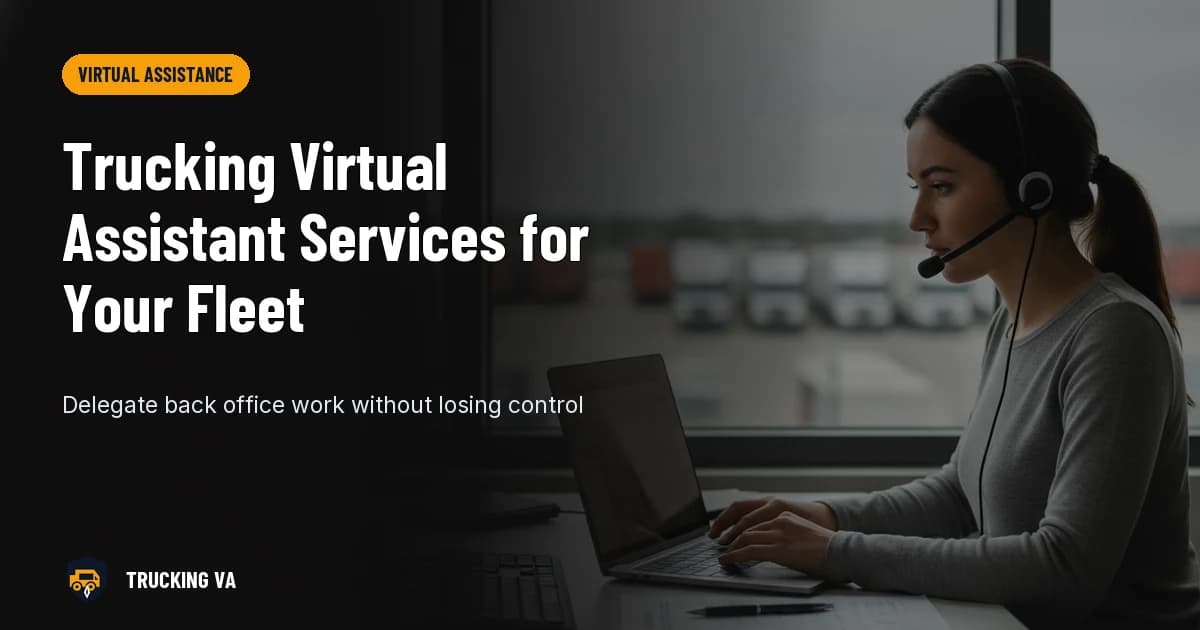
Understanding Trucking Virtual Assistant Services
The FMCSA reported over 590,000 active motor carriers operating in the United States, and that number continues to climb each year. Every one of those carriers faces a growing mountain of administrative work that diverts attention from the core business of hauling freight.
Trucking virtual assistant services provide remote professionals who specialize in the day-to-day back-office tasks that keep a carrier running. These are not general-purpose assistants answering emails and scheduling meetings. They understand bills of lading, rate confirmations, carrier packets, and FMCSA compliance requirements.
You are likely here because your operation is growing faster than your in-house team can handle. Perhaps you are an owner-operator spending more time on paperwork than behind the wheel. Maybe you run a small fleet and your dispatcher is buried under load booking, invoicing, and driver communication at the same time.
Whatever your situation, trucking virtual assistant services offer a proven way to reclaim those lost hours without the expense of hiring full-time office staff. The right VA can handle everything from load posting and invoicing to safety documentation and driver onboarding packets.
This model of outsourced support has gained traction across the industry over the past several years. Owner-operators and small fleet managers in particular have embraced it as a cost-effective alternative to building a traditional office team. Learn more about the broader advantages in our guide on Benefits Of Virtual Assistants In Trucking.
Why Trucking Virtual Assistant Services Matter
Running a trucking operation means juggling dozens of tasks every single day. From tracking hours of service to filing BOL paperwork, every missed detail can lead to fines, service failures, or lost revenue.
The administrative burden on small and mid-size carriers has grown dramatically over the past decade. Electronic logging devices, stricter compliance audits, and tighter insurance requirements have added layers of documentation that someone has to manage.
Trucking virtual assistant services give you trained support at a fraction of the cost of a full-time office employee. You get the flexibility to scale your back-office workforce up or down based on seasonal freight volume and business needs.
These services also reduce the risk of burnout among your existing team members. When your dispatcher no longer has to handle invoicing, compliance filings, and customer follow-ups on top of their core duties, the quality of every task improves.
- Reduced overhead costs compared to hiring full-time office staff for repetitive administrative roles
- Faster turnaround on load booking, invoicing, carrier packets, and rate confirmations
- Improved DOT and FMCSA compliance through dedicated, detail-oriented document management
- More time for you to build shipper relationships, negotiate better rates, and grow your business
Key Considerations for Trucking Virtual Assistant Services
- Industry-Specific Training - Your VA should understand freight terminology and carrier operations.
- Communication Reliability - Confirm time zone overlap and response time expectations upfront.
- Software Proficiency - Look for experience with TMS, ELD, and load board platforms.
- Data Security Practices - Verify how sensitive carrier and driver information is protected.
- Scalable Engagement Model - Choose between hourly, part-time, or full-time arrangements as needed.
Step-by-Step Approach
Getting started with trucking virtual assistant services does not have to be complicated. A structured onboarding process helps you find the right fit and set clear expectations from the very first day.
Many carriers make the mistake of skipping the planning phase entirely. They hire a VA, hand over a login, and hope for the best. The steps below will help you avoid that trap and build a productive working relationship from the start.
-
Audit your current workload by listing every administrative task performed each week, including dispatching, invoicing, compliance filing, customer communication, and driver onboarding paperwork. Estimate how many hours each task consumes so you can prioritize what to delegate first.
-
Write a detailed job description that outlines required skills, expected working hours, communication preferences, and specific performance metrics you plan to track. Be explicit about whether you need help with dispatching, bookkeeping, safety compliance, or all of the above.
-
Search for providers that specialize in trucking virtual assistant services rather than general-purpose virtual assistant agencies. Industry-specific providers pre-train their teams on TMS platforms, load boards, and carrier compliance workflows.
-
Interview candidates using scenario-based questions about real situations they will face. Ask how they would handle a rate confirmation discrepancy, a missing proof of delivery, or an ELD violation notification.
-
Start with a paid trial period of two to four weeks to evaluate responsiveness, accuracy, and communication quality. Set specific deliverables for the trial so you have clear benchmarks to measure against.
-
Provide access to your transportation management system, accounting software, and communication tools with role-based security permissions. Avoid giving full administrative access on day one.
-
Establish daily check-ins for the first two weeks, then transition to weekly reviews as your VA demonstrates competence. Use these sessions to address questions, correct mistakes early, and provide constructive feedback.
-
Gradually expand responsibilities as your virtual assistant proves reliable and accurate. Many carriers start with data entry and invoicing before adding dispatching, compliance management, or customer-facing communication.
Common Mistakes to Avoid
Even experienced fleet managers stumble when they first outsource administrative tasks to a remote team member. The most common errors happen before the VA even starts working, during the planning and hiring phase.
Understanding these pitfalls ahead of time will save you weeks of frustration and thousands of dollars in wasted effort. Each of these mistakes has a simple fix, but only if you address it before you sign a contract.
The first major mistake is treating trucking virtual assistant services like a plug-and-play solution. No VA, no matter how experienced, can read your mind or guess your preferred workflow without proper documentation and training.
The second common error is choosing the cheapest option without evaluating quality. A VA who charges $5 per hour but makes constant data entry errors will cost you far more in corrections, lost loads, and compliance penalties than a skilled professional at a higher rate.
A third issue is failing to set measurable goals and key performance indicators from the start. Without clear benchmarks, you have no objective way to evaluate whether your trucking virtual assistant services are delivering real value or just adding another layer of complexity to your operation.
- Hiring a generalist VA with no experience in trucking or logistics operations
- Failing to document your standard operating procedures before onboarding begins
- Giving full system access on day one without a phased, role-based security approach
- Skipping regular performance reviews and feedback sessions during the first 90 days
Numbers to Know
Understanding the financial impact of trucking virtual assistant services helps you make a data-driven investment decision. The numbers consistently favor remote support over traditional in-house hires for small and mid-size carriers.
Administrative overhead is one of the largest non-fuel expenses for trucking companies. Industry data shows that back-office costs can consume a significant share of gross revenue, especially for fleets running fewer than 50 trucks.
When you compare the fully loaded cost of an in-house employee to a virtual assistant, the savings become obvious. You eliminate expenses for office space, equipment, benefits, payroll taxes, and paid time off.
The productivity gains are just as compelling as the cost savings. Carriers that use dedicated virtual assistants consistently report that they spend more time on revenue-generating activities and less time buried in paperwork.
- The average cost of a full-time office employee in trucking exceeds $45,000 per year when you factor in benefits, payroll taxes, and overhead
- Trucking virtual assistant services typically range from $8 to $25 per hour depending on skill level, experience, and geographic location
- Carriers using dedicated VAs report saving 15 to 20 hours per week on administrative tasks like invoicing, data entry, and compliance filings
- Fleets that outsource back-office work often see a 10 to 15 percent reduction in billing errors and compliance documentation gaps
Next Steps
You now have a clear picture of what trucking virtual assistant services can do for your operation and how to get started the right way. The next move is to evaluate your current workload honestly and identify which tasks are consuming the most time with the least strategic value.
Start by listing every administrative task you or your team handles each week. Prioritize the ones that are repetitive, time-consuming, or prone to human error. These are the first tasks you should delegate to a trucking virtual assistant.
Consider your compliance workload as a high-priority area for delegation. For carriers managing DOT and FMCSA regulatory requirements, our resource on Dot Compliance Checklist For Carriers can help you organize that side of your operation before bringing a VA on board.
Once you have your task list and priorities mapped out, you are ready to find the right provider. Look for a team that understands your specific needs, whether you run a single truck or manage a growing fleet.
Ready to find the right trucking virtual assistant for your fleet? Visit our contact page to speak with a specialist who can match you with a trained VA today.