trucking back office operations
Measuring Driver Pay Dispute Resolution Without Overclaiming
A research brief on reviewing driver pay disputes, separating the dispute, the evidence, the correction, and the payment from a claim about payroll accuracy.
Trucking VA Research Team · · 7 min read · 4 sources
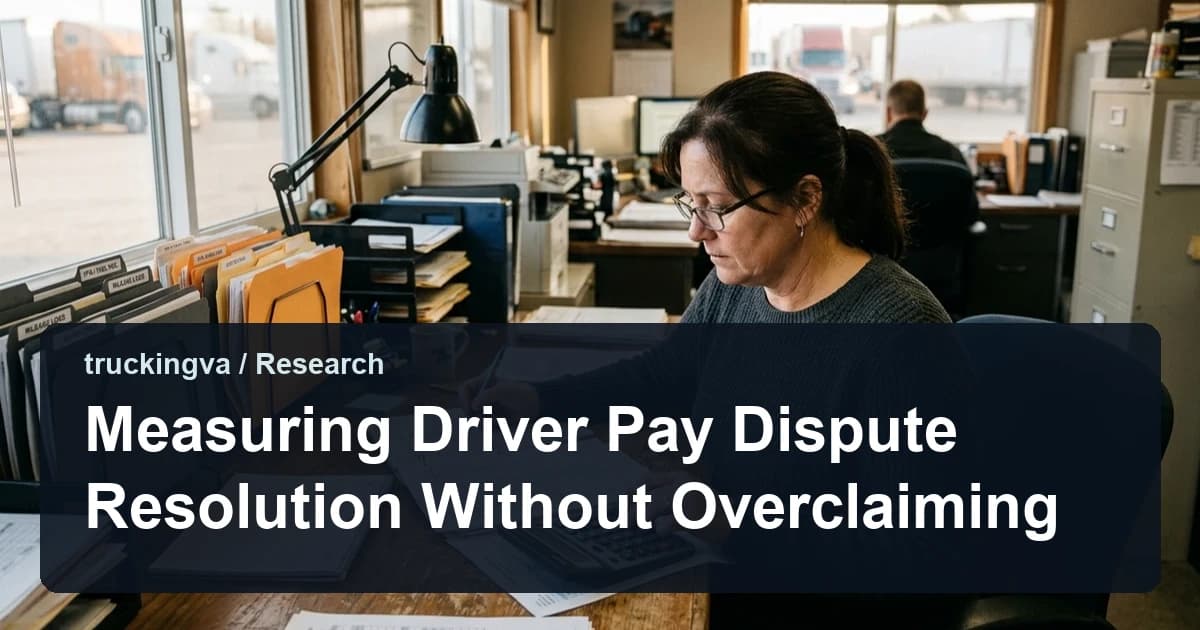
Table of contents16 sections
Key takeaways
- A closed dispute is not the same as a corrected payment.
- Record the dispute, the evidence, the decision, and the payment as separate stages.
- Separate a missing document from a disagreement about the rate or the miles.
- Use the review to fix the evidence path, not to rank drivers or payroll staff.
A driver calls about a settlement that looks short. The dispatcher checks the load, the payroll clerk checks the miles, and the answer depends on a document nobody can find. The dispute closes when the driver stops calling, but the payment may still be wrong. Driver pay disputes are a useful operating signal because they sit at the intersection of dispatch, payroll, and recordkeeping. They are also easy to measure badly. A resolution time can look good while the underlying evidence path remains broken.
What the measure can show
The measure can show how many disputes were reported, how long each stage took, and whether a correction was paid. It can show the categories that produce the most disputes and the documents that are most often missing. It can also show the disputes that remain open. Those facts support a review of the evidence path. A cluster of disputes about detention may indicate a missing time record. A cluster about accessorials may indicate a rate sheet that is not shared with dispatch.
What the measure cannot show
The measure cannot show whether the original payment was correct in every case. It cannot show whether a driver did not report a problem or whether payroll made an error that nobody noticed. It also cannot show whether the resolution was fair. The measure cannot prove payroll accuracy without a separate review of the underlying records. A low dispute count is not proof of a good process, and a high count is not proof of a bad one.
Methodology
This brief reviews public guidance on wage and hour administration, workforce context, internal control, and records, and maps it to a private driver settlement process. The sources support documentation and review discipline. They do not prescribe a pay rule or a resolution target. We tested the model against four common cases: a missing proof of delivery, a disputed detention charge, a rate that changed after the load was booked, and a deduction the driver did not recognize. The proposed stages are an operating design.
Record the dispute before answering
Record the driver, the settlement period, the load or loads, the amount in question, and the driver's description of the problem. Add the date and the channel. A dispute recorded after the answer is given loses the detail that made it useful. Assign a category such as miles, rate, detention, accessorial, deduction, or other. The category should be stable enough to compare across weeks. It should not be so detailed that the person recording it needs a glossary.
Separate the evidence from the decision
Record the documents used to answer the dispute, such as the rate confirmation, the proof of delivery, the scale ticket, or the time record. Note the date each document was received. The evidence path is often the real source of delay. Then record the decision and the reason. A decision that says the payment was correct is still a decision, and it should name the document that supports it. A decision that says a correction is due should name the amount and the pay period.
Track the correction to the payment
A dispute is not resolved when the decision is made. It is resolved when the correction appears in a payment the driver can see. Record the correction amount, the pay period, and the payment date. If the correction is carried to the next settlement, say so and give the expected date. A promise to pay later is not the same as a payment. The record should make the difference visible to the next person who reviews the file.
Separate a missing document from a disagreement
A missing document is a process problem that the team can fix. A disagreement about the rate or the miles is a judgment that may need a supervisor or a contract review. Treating both as the same kind of dispute hides the different fixes. Record the subcategory and the owner. A missing proof of delivery may belong to dispatch, while a rate disagreement may belong to the account manager. The right owner shortens the resolution without pressuring the driver.
Set a response expectation
Set a first-response expectation and a resolution expectation separately. The first response acknowledges the dispute and names the owner. The resolution follows the evidence and the decision. Do not promise a resolution date that depends on a document nobody has. Give the driver the next checkpoint instead. A realistic checkpoint protects trust better than an optimistic promise that slips.
Review by category and evidence gap
At the end of each month, review the disputes by category and by missing document. Look for the evidence that is most often absent and the stage where the dispute waits longest. The pattern is more useful than an average resolution time. Change one thing based on the review, such as a required photo at delivery or a shared rate sheet. Record the change and the date. A review that produces no change becomes another report.
Protect driver and payroll information
Dispute records can include pay amounts, deductions, and personal details. Keep them in the approved payroll system and limit access to the people who need them. Do not discuss an individual dispute in a broad dispatch channel. Set a retention period with the organization's records policy. A dispute log kept indefinitely creates risk without adding insight. The record should be long enough to support a payroll review and short enough to protect the driver.
Keep the sample honest
A review of one month and one fleet is a check, not a benchmark. Say so in the summary. Include the dispute count, the categories, and the open items so the reader can judge the evidence. A small sample can show a pattern but cannot support a percentage for every driver group. Repeat the review before a conclusion is treated as stable, and state the limits in the same document as the result.
Share the evidence path with drivers
Drivers should know which documents support a pay question and how to ask for a review. A short note in the onboarding packet can explain the proof of delivery, the scale ticket, and the time record. That note reduces the number of disputes that begin with a missing document. It also gives the driver a fair starting point when the settlement looks short. The note should name the contact and the expected response window. It should also say what happens when a document is missing, so the driver is not left to guess.
Bounded pilot
Review one month of driver pay disputes. Record the dispute, the evidence, the decision, the correction, and the payment. Report the open items and the missing documents. Ask a reviewer who did not handle the disputes to trace three corrections to a payment. If they cannot, the fields need work.
Limitations
This brief describes an operating review model. It does not establish a pay standard, a legal obligation, or a measure of payroll accuracy. The cited sources support general wage, control, and records principles. Results depend on the completeness of the evidence and the accuracy of the payment record.
Sources
- Wage and Hour Division; U.S. Department of Labor; checked November 11, 2026.
- Heavy and Tractor-Trailer Truck Drivers; U.S. Bureau of Labor Statistics; checked November 11, 2026.
- The Green Book; U.S. Government Accountability Office; checked November 11, 2026.
- Records Management; U.S. National Archives and Records Administration; checked November 11, 2026.
Conclusion
Driver pay dispute resolution is useful when the dispute, the evidence, the decision, and the payment are recorded separately. The measure cannot prove payroll accuracy. It can show where the evidence path breaks and which document or handoff needs a change. For related workflows, see the dock appointment no-show brief and the trucking VA services overview.
Sources and citations
- U.S. Department of Labor, Wage and Hour Division, https://www.dol.gov/agencies/whd, retrieved 2026-11-11
- U.S. Bureau of Labor Statistics, Heavy and Tractor-Trailer Truck Drivers, https://www.bls.gov/ooh/transportation-and-material-moving/heavy-and-tractor-trailer-truck-drivers.htm, retrieved 2026-11-11
- U.S. Government Accountability Office, Standards for Internal Control in the Federal Government, https://www.gao.gov/greenbook, retrieved 2026-11-11
- U.S. National Archives and Records Administration, Records Management, https://www.archives.gov/records-mgmt, retrieved 2026-11-11